A Shrine Built Around a Waterfall
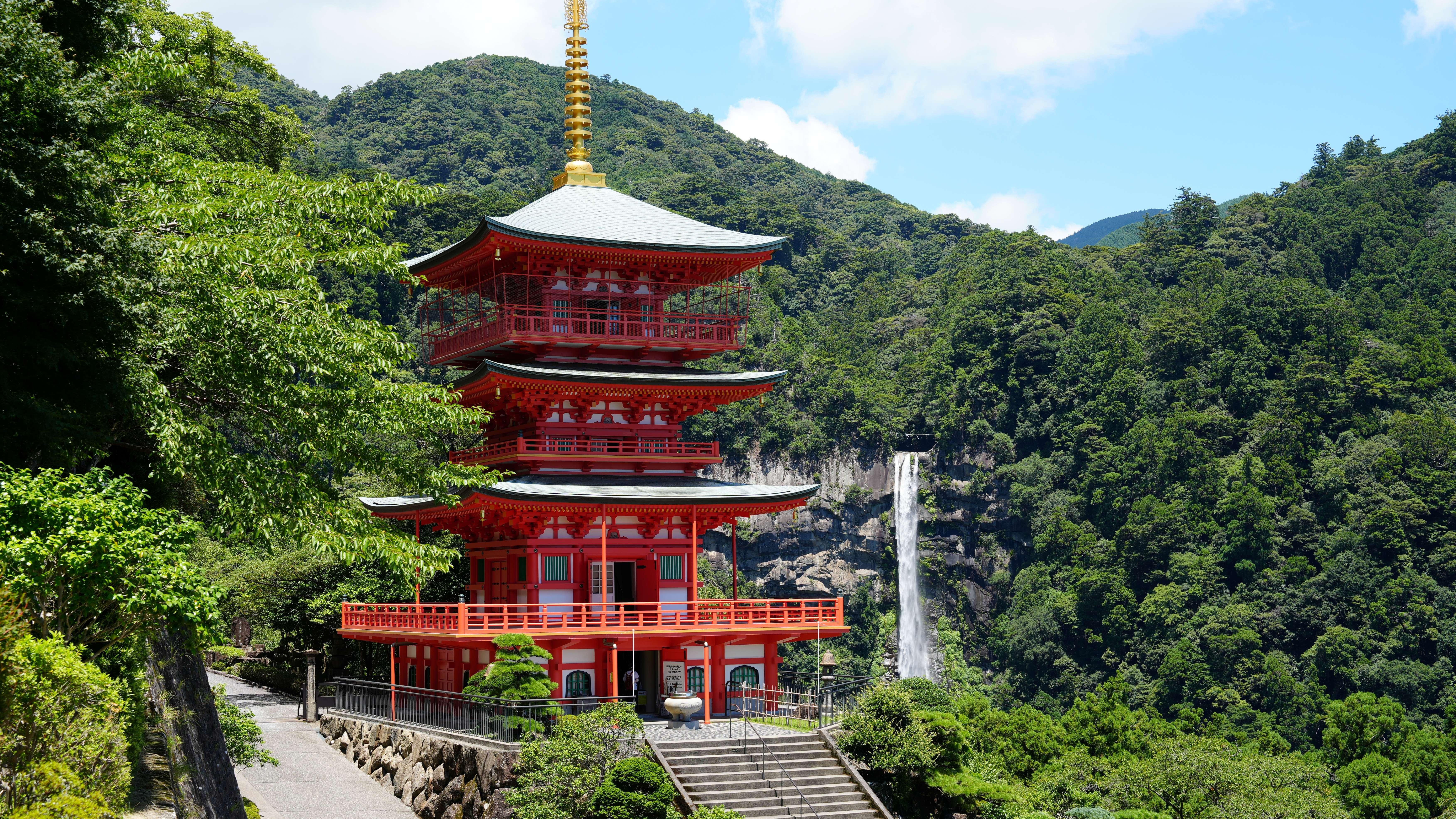
Kumano Nachi Taisha is one of the three Kumano grand shrines — the Kumano Sanzan — and the reason it stands where it does is visible from its courtyard: Nachi Falls, a 133 m single drop, the tallest in Japan, falling through the forest below. The shrine complex sits partway up the mountainside, its vermilion halls set against dark cedar, with a sacred camphor tree standing in the grounds. All of it belongs to UNESCO’s “Sacred Sites and Pilgrimage Routes in the Kii Mountain Range” listing (2004).
Getting up there is part of the visit. From the village street below, a stairway of about 467 stone steps climbs to the shrine gate — a steady, honest climb rather than a scramble. Pilgrims historically arrived on foot along the Kumano Kodo trail network; the last stretch of that approach, the cedar-lined Daimon-zaka slope, is still the best way to walk in.
- What it is: One of the three Kumano Sanzan grand shrines
- The climb: About 467 stone steps from the village street
- In the grounds: Vermilion halls, sacred camphor tree
- Next door: Seiganto-ji temple — shrine and temple side by side
- Below: Nachi Falls (133 m) and Hirou-jinja at its base
- UNESCO: Sacred Sites and Pilgrimage Routes in the Kii Mountain Range (2004)
- Access: Bus from JR Kii-Katsuura, ~30 min, ¥420–620 (as of mid-2026)
Shrine and Temple, Side by Side
Directly beside the shrine stands Seiganto-ji, a Tendai Buddhist temple and the first temple of the Saigoku 33-temple Kannon pilgrimage. This is not a coincidence of geography — for most of their history, shrine and temple functioned as one sacred complex. When the Meiji government ordered Buddhism and Shinto separated in the late 19th century, most such pairings were broken up; Nachi Taisha and Seiganto-ji survived together, which is why you can still walk from vermilion shrine gate to temple main hall in a minute.
For visitors the practical meaning is simple: you visit both, always. There is no fence between them, and the famous view of Seiganto-ji’s three-story pagoda with the falls behind it is part of the same walk. Treat “shrine or temple?” as a question of history, not of route planning.
How a Visit Flows
The mountain has a natural order. Walk it top-heavy: climb first, descend to the falls last.
1. Daimon-zaka Up
Start at the Daimon-zaka bus stop and walk the ~600 m stone-paved, cedar-lined slope — roughly 30–40 minutes uphill and the most accessible taste of the Kumano Kodo pilgrimage trails. It delivers you to the base of the shrine stairway.
2. The Shrine
Climb the stone steps — about 467 of them — to Kumano Nachi Taisha itself. The vermilion halls, the sacred camphor tree, and the first clear look at the falls from the courtyard. Shrine grounds are free.
3. The Temple & Pagoda
Step next door to Seiganto-ji — the main hall, then downhill to the three-story pagoda where the falls line up behind the tower for the photograph everyone comes for.
4. Down to the Falls
Descend through the forest to Hirou-jinja at the base of Nachi Falls. The approach is free; the paid ¥300 viewing platform (¥200 junior-high and younger, as of mid-2026) puts you closest to the water. Bus stops back to Kii-Katsuura are nearby.
The Falls Are the Deity
At the base of the drop stands Hirou-jinja — and here the usual logic of a shrine visit inverts. The waterfall itself is the deity. There is no hall housing a hidden object of worship; the 133-meter column of water is what you stand before. That is why Nachi Falls has been a site of worship since long before the buildings above it, and why the shrine at its base feels less like architecture and more like a threshold.
Once a year the mountain makes this relationship loud: on July 14, the Nachi Fire Festival (Nachi no Ogi Matsuri) sends twelve large pine torches down the stone steps to purify the path for twelve mikoshi representing the falls. If your dates are close to mid-July, the seasons guide covers what to expect — and how crowded it gets.
Visiting on a Tour
One guided day from Osaka covers all three Kumano grand shrines — with the longest stop here at Nachi.
UNESCO Kumano Kodo: Complete 3 Grand Shrines & Nachi Hike
Full-day coach tour from Osaka: Hongu Taisha and the Oyunohara torii, Hayatama Taisha, then the long block at Nachi — shrine, temple, Daimon-zaka, and the falls. Guaranteed departures, as of mid-2026.
Check AvailabilityKumano Nachi Taisha FAQ
The practical questions, answered without padding.
The stairway from the village street up to the shrine is commonly counted at about 467 stone steps. It is a steady climb rather than a scramble — most visitors take 15–25 minutes with photo pauses. Arriving via the Daimon-zaka slope adds a 30–40 minute cedar-lined walk before the steps.
It is a Shinto shrine — one of the three Kumano grand shrines. The Buddhist temple Seiganto-ji stands directly beside it, and the two have shared the mountainside for centuries, surviving the Meiji-era order to separate Buddhism and Shinto. You visit both in one continuous walk.
The shrine grounds and the approach to Hirou-jinja at the base of the falls are free. The paid viewing platform closest to Nachi Falls costs ¥300 (¥200 for junior-high age and younger), as of mid-2026 — where each entrance sits is easiest to see on the Nachi area map.
Hirou-jinja is the shrine at the base of Nachi Falls, and its object of worship is the waterfall itself — the 133 m drop is the deity, not a building. There is no separate hall to enter; you stand before the falls. The free approach leads to the torii, and the ¥300 platform (as of mid-2026) puts you closest to the water — more on the falls themselves in the Nachi Falls guide.
The Nachi no Ogi Matsuri is held each year on July 14. Twelve large pine torches are carried down the stone steps to purify the path for twelve mikoshi representing the falls. It is the busiest day of the year on the mountain — timing notes are in the seasons guide.
The gateway is JR Kii-Katsuura station. From the station, buses run toward Nachi-san in about 30 minutes, ¥420–620 depending on the stop, as of mid-2026 — get off at Daimon-zaka to walk the pilgrimage slope up, or ride further if you prefer to start at the shrine steps. Train connections from Osaka and Tokyo are in the getting-there guide.
Not realistically by public transport — Nachi, Hongu, and Hayatama Taisha are spread across the Kii Peninsula. A guided day tour from Osaka covers all three plus the Nachi walk in one day (4.87 from 124 reviews, from $111 per person, as of mid-2026) — the route is laid out in the Kumano Sanzan guide.