Temple #1 of the Saigoku Pilgrimage
Seiganto-ji (青岸渡寺) is a Tendai Buddhist temple and Temple #1 of the Saigoku 33-temple Kannon pilgrimage — the traditional starting point of a circuit that crosses western Japan. That ranking is not ornamental: worship at Nachi is older than the pilgrimage itself, centered on the 133 m waterfall below, and the temple grew up on the mountainside beside it. Together with the shrine next door, it belongs to UNESCO’s “Sacred Sites and Pilgrimage Routes in the Kii Mountain Range” listing (2004).
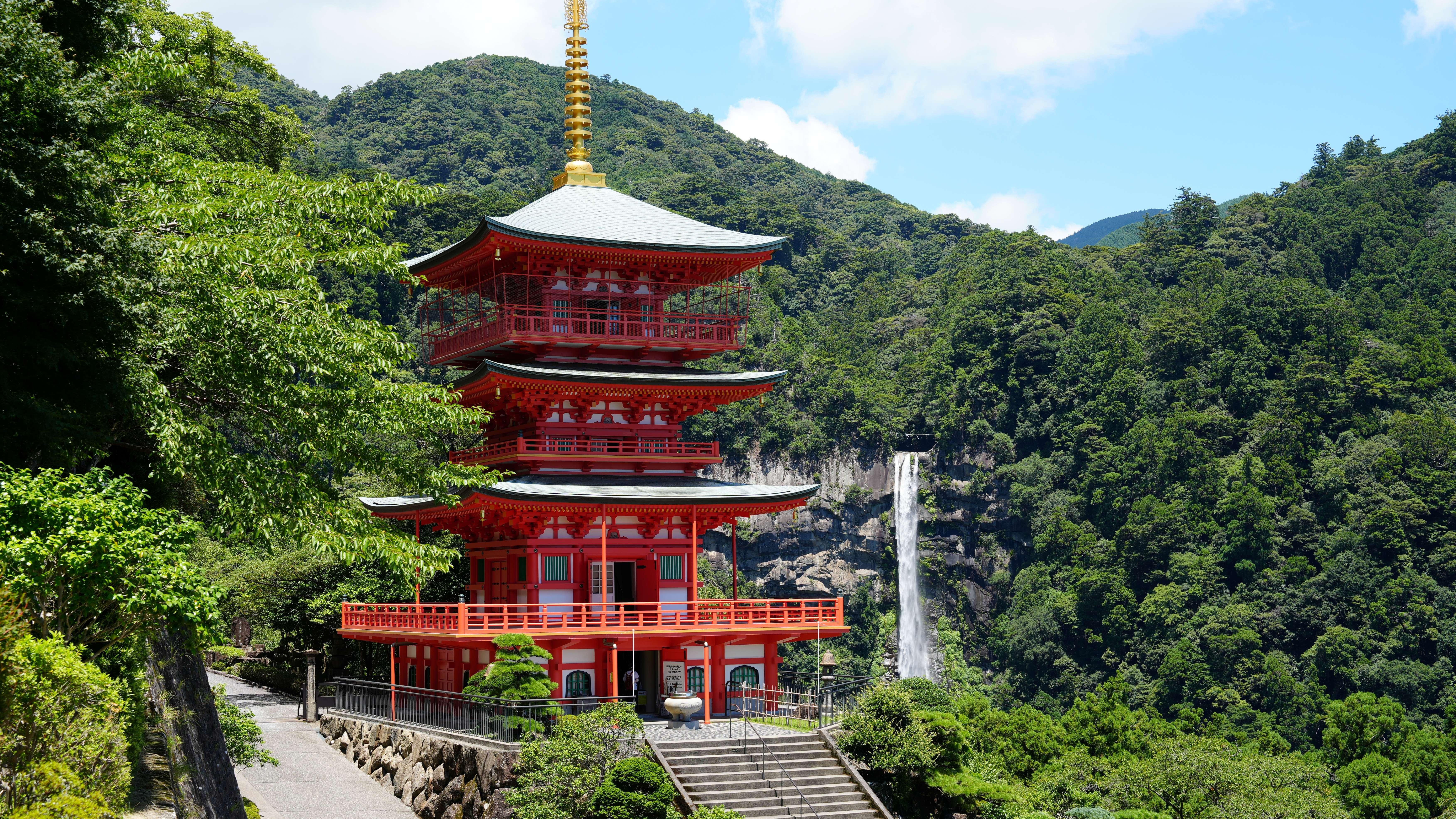
Most visitors, though, come for one image: the temple’s three-story vermilion pagoda with Nachi Falls dropping behind it — Japan’s most photographed pagoda-and-waterfall pairing, and the picture that stands in for the whole Kumano region. The good news is that the view is not a secret trailhead or a drone angle. It is on the temple grounds, a short walk from the main hall.
- What it is: Tendai Buddhist temple, Saigoku Kannon pilgrimage Temple #1
- The photo: Three-story vermilion pagoda with the 133 m falls behind
- Next door: Kumano Nachi Taisha — one continuous visit
- Grounds: Free to walk; pagoda interior/deck has a small fee
- Approach: Same stone stairway / Daimon-zaka slope as the shrine
- UNESCO: Sacred Sites and Pilgrimage Routes in the Kii Mountain Range (2004)
The Photograph: Where to Stand
The most famous frame in Kumano takes about two minutes to find. Here is how.
Find the Pagoda
From Seiganto-ji’s main hall, follow the path downhill toward the three-story pagoda. It stands apart from the other temple buildings, on open ground facing the valley — you cannot miss it.
Line Up the Falls
From the open ground around the pagoda, the tower and the 133 m drop of Nachi Falls line up in a single frame. Move a few steps at a time — small changes in position change how pagoda and waterfall stack against each other. Wider shots take in the forested valley between them.
Light & Timing
Morning is generally the kinder window — the scene sits against the mountainside, and earlier light tends to hold more shape in the falls before the day flattens it. Haze and rain change the mood rather than ruin it; the falls run fullest after rain, as the seasons guide explains.
Climb the Pagoda
The pagoda itself can be entered for a small fee (as of mid-2026), with an upper deck that puts the falls at eye level across the valley. Worth it if you want the reverse angle: waterfall framed by the pagoda, rather than behind it.
One Mountainside, Shrine and Temple Together
Seiganto-ji does not stand alone. Directly beside it is Kumano Nachi Taisha, one of the three Kumano grand shrines — and for most of their history the two functioned as a single sacred complex. When the Meiji government ordered Buddhism and Shinto separated in the late 19th century, most paired institutions across Japan were split apart or demolished; here, shrine and temple survived side by side. Walking between them takes about a minute, and there is no boundary to notice unless you are looking for it.
Practically, that means Seiganto-ji is never a separate trip. The approach is the same: bus from JR Kii-Katsuura toward Nachi-san, then either the cedar-lined Daimon-zaka slope (roughly 30–40 minutes uphill) or a higher stop, followed by the stone stairway of about 467 steps. Shrine, temple, pagoda, and the descent to the falls form one continuous walk — full transport details are in the getting-there guide.
Visiting on a Tour
The guided day from Osaka includes Seiganto-ji and the pagoda view in its long Nachi stop.
UNESCO Kumano Kodo: Complete 3 Grand Shrines & Nachi Hike
Full-day coach tour from Osaka covering all three Kumano grand shrines, with its longest block at Nachi — shrine, Seiganto-ji, the pagoda, Daimon-zaka, and the falls. Guaranteed departures, as of mid-2026.
Check AvailabilitySeiganto-ji FAQ
The practical questions, answered without padding.
At Seiganto-ji itself. The three-story vermilion pagoda stands downhill of the temple’s main hall, and from the open ground around it the pagoda and the 133 m falls line up in one frame. Walk the path from the main hall toward the pagoda and adjust a few steps at a time — the exact spot is marked on the Nachi area map.
A temple — Tendai Buddhist. The Shinto shrine Kumano Nachi Taisha stands directly beside it. The two survived the Meiji-era separation of Buddhism and Shinto together, so a visit flows naturally through both.
Yes — the pagoda has an interior and an upper deck, for a small fee (as of mid-2026), with the falls in view from up top. The temple grounds themselves are free to walk; how the pagoda fits the wider walk is covered in the photo section above.
The Saigoku pilgrimage is a circuit of 33 temples dedicated to Kannon across western Japan, and Seiganto-ji is Temple #1 — the traditional starting point. Its place at the head of the route reflects how old the worship at Nachi is: the temple grew up beside a waterfall venerated long before the pilgrimage existed, as the Kumano Sanzan guide explains.
The same way as Nachi Taisha next door: bus from JR Kii-Katsuura station toward Nachi-san (about 30 minutes, ¥420–620 as of mid-2026), then either the Daimon-zaka cedar-lined slope and the stone stairway of about 467 steps, or a higher bus stop to shorten the climb.
Yes — the guided day tour from Osaka that covers all three Kumano grand shrines includes Seiganto-ji and the pagoda view in its Nachi block, alongside the shrine and the falls (4.87 from 124 reviews, from $111 per person, as of mid-2026) — see the booking section.