Season by Season
What the mountain actually does across the year — expand a season for the honest picture.
Spring rains begin feeding the falls toward their fullest, and the cedar-lined Daimon-zaka slope is fresh and green. A dependable season: comfortable walking weather, and the water already carrying real weight over the 133 m drop.
The rains of early summer push the falls to their fullest flow of the year — this is Nachi at maximum volume, spray drifting across the viewing platform. It is also festival season: the Nachi Fire Festival on July 14, described in full below. Expect heat and humidity on the stone paths; early starts are kindest. Late summer begins the typhoon watch — see the autumn entry.
Two-faced. Early autumn overlaps typhoon season: storms can suspend or delay the Kuroshio trains along the coast, so check status on the day and keep plans flexible if traveling September into early October. Then the reward: on the warm Kii coast the leaves turn late — around late November — when the color frames the vermilion halls of Kumano Nachi Taisha long after the famous foliage spots up north have finished.
The underrated season. Winter brings the clearest air of the year — the pagoda-and-falls view at its sharpest — and the fewest visitors on the stone stairways. The rail-and-bus route runs year-round, and an onsen evening in Kii-Katsuura below completes the argument.
The Nachi Fire Festival — July 14
Once a year, the falls come up the mountain. The Nachi no Ogi Matsuri, held each year on July 14, is the great rite of Kumano Nachi Taisha — and one of the most striking festival sights in Japan.
What happens
Twelve large pine torches are carried down the stone steps toward the falls, their flames purifying the path for twelve mikoshi — portable shrines representing the falls themselves. Fire descends, the falls’ emblems follow: the meeting of the two is the heart of the rite. This is a working religious ceremony of a shrine whose deity is the waterfall — watch it as a guest, not an audience.
Practicalities
- Expect crowds. This is the region’s signature festival day, and the stone stairways hold only so many people.
- Arrive early. The earlier you are on the mountain, the better you stand — staying the night before in Kii-Katsuura makes an early arrival easy.
- Check details near the date. We keep to general advice here: timings and access arrangements on the day are the shrine’s to set, so confirm locally as July 14 approaches.
Timing the Famous Photograph
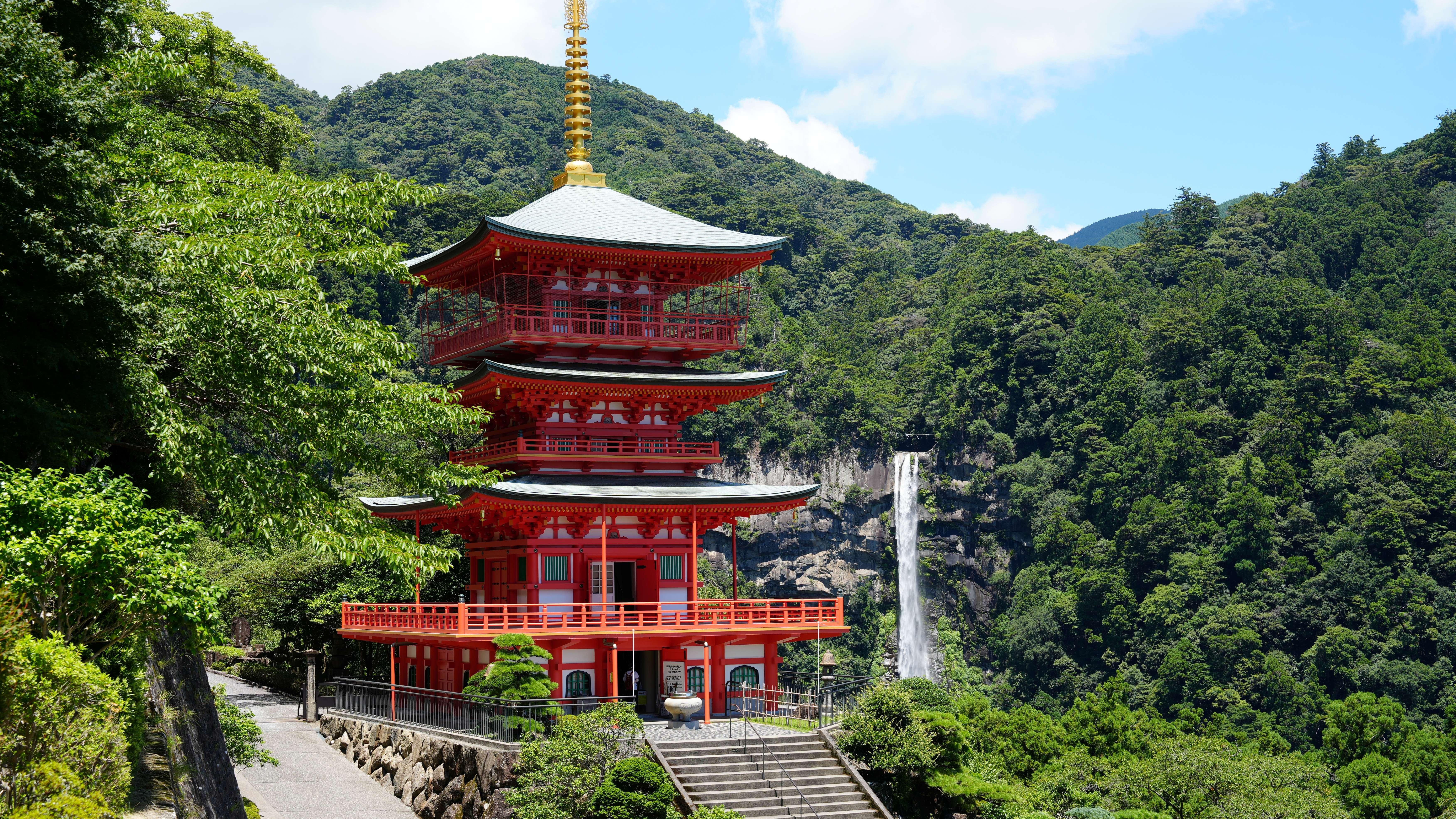
The pagoda-and-falls frame — the three-story vermilion pagoda of Seiganto-ji with the full 133 m drop behind it — is the image most visitors come for, and it rewards a little timing sense:
- After rain the falls run fullest and mist moves through the valley — the most dramatic conditions the frame gets.
- Early morning is quietest; day-trip arrivals from Osaka concentrate around midday. The first bus up from Kii-Katsuura station buys you the calm hours.
- Late November adds foliage color to the frame; winter trades color for the sharpest air of the year.
See It in Any Season
UNESCO Kumano Kodo: Complete 3 Grand Shrines & Nachi Hike
From Osaka, year-round: all three Kumano grand shrines, the world’s largest torii gate at Oyunohara, a Daimon-zaka walk and time at the falls — guaranteed departures, free cancellation.
Every bookable option is compared in the tours and prices section.
Seasons & Festival FAQ
Timing questions, answered plainly.
Each year on July 14. Twelve large pine torches are carried down the stone steps to purify the path for twelve mikoshi representing the falls. Expect crowds and arrive early — the practical move is to stay the night before in the port town below, covered in the Kii-Katsuura guide.
The falls run year-round, so there is no wrong season — only different ones. Spring and summer bring the fullest flow after the rains; late November brings the color; winter brings clear air and quiet paths. Whenever you come, the cedar-lined Daimon-zaka walk up is the right way to arrive — see the Kumano Kodo day hike guide.
Late — the Kii coast is warm, so the color arrives around late November, well after the famous foliage regions further north. Time it right and the color frames the vermilion halls of Kumano Nachi Taisha above the falls.
Quietly, yes. Winter brings the clearest air of the year and the fewest visitors — the stone paths and the falls approach are at their most still. Access is unchanged: the rail-and-bus route runs year-round, as laid out in the getting-there guide.
It can. Late summer into early autumn is typhoon season on the Kii coast, and storms can suspend or delay the Kuroshio limited express along the coastal line. If your dates fall in that window, check train status on the day and build slack into your plan — the autumn entry in the season-by-season section above covers how the risk tapers.
The classic frame — the three-story vermilion pagoda with the 133 m falls behind — works in every season; after rain the falls run fullest and mist moves through the valley, which many photographers prize. Early morning is quietest before day-trip arrivals. Where to stand and what the pagoda itself is are covered in the Seiganto-ji guide.